


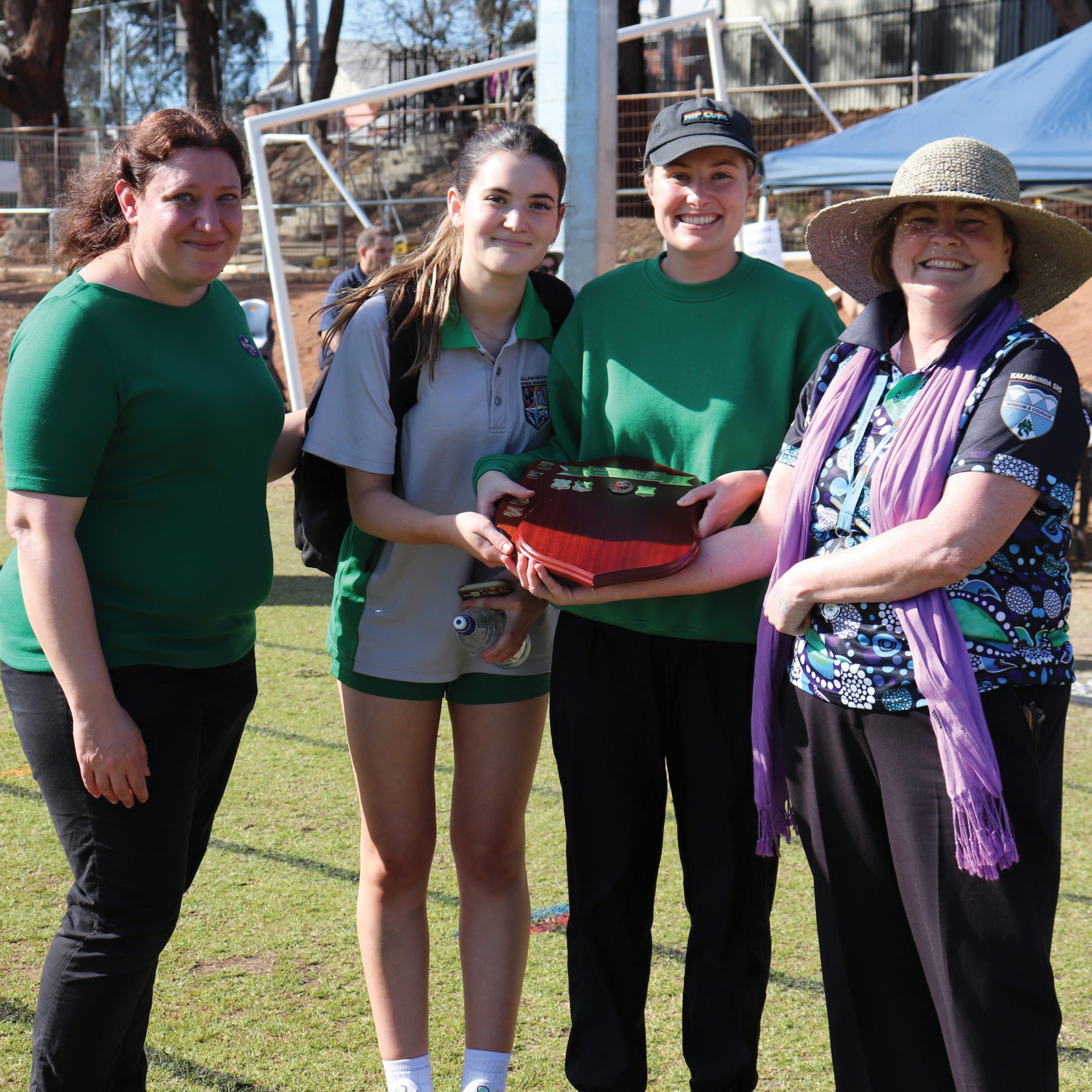
Student Learning
Our staff are committed to providing a quality education for students. They are passionate about their Learning Area and their teaching practice. Together they have worked to articulate what they share in common about teaching. This is known as the School Wide Pedagogy (SWP) and has the elements of: collaborating, reflecting, engagement and relevance.
The curriculum comprises of 8 Learning Areas. English, Health and Physical Education, Languages other than English, Mathematics, Science, Society and Environment, Technology and Enterprise and The Arts.
Most Learning Areas have a Head of Learning Area and Languages has a Teacher in Charge. If parents have any questions about the learning program, their first port of call is the classroom teacher. If further assistance is required, parents should make contact with the relevant Head of Learning Area.
Learning Centre
The Learning Centre staff provide assistance and support to students with particular learning needs along with support in literacy and numeracy. Staff provide one on one, small group and support to class groups in effective strategies aimed at improving student academic achievement. They also provide advice and support in developing differentiated plans for students with learning difficulties or specific diagnosed educational needs.
Education Assistants
The school employs a number of experienced education assistants to work alongside the teachers in accommodating students who have particular learning needs.
Years 7 to 10 Curriculum
The school is following the guidelines for implementation of the Western Australian and Australian Curriculum. Further information can be found on the School Curriculum and Standards Authority (SCSA) website.
Years 11 and 12
In Senior School students follow either a General, ATAR (Australian Tertiary Admissions Rank) or Vocational (Certificate course) pathway.
An ATAR pathway is typically for those students intending on furthering their education at university.
A Vocational or General pathway is for students who intend on either entering the workforce or furthering their education in a TAFE organisation.
At Kalamunda we aim for all students to complete their schooling with a sense of achievement and a meaningful pathway in their chosen field. Nearly all of our students graduate each year with a WACE (Western Australian Certificate of Education)
Further information on the WACE requirements can be found on the SCSA website.
Kalamunda SHS encourages all students to do their very best and they are monitored closely by staff in this regard.
A Good Standing Policy sets out the expectations for students and is used to monitor attendance, behaviour and academic achievement.
Parents are informed of student progress through a range of avenues including:
- Telephone conversations
- Emails
- SMS messaging (particularly for absences)
- Parent meetings and interviews
- Letters of Commendation/Concern
- Interim Reports
- Formal Reports (each semester)
Good Standing and Assessment policies are outlined in School Policies and Procedures
The Arts Curriculum aims to develop students':
- creativity, critical thinking, aesthetic knowledge and understanding about arts practices, through making and responding to artworks with increasing self-confidence
- arts knowledge and skills to communicate ideas; they value and share their arts and life experiences by representing, expressing and communicating ideas, imagination and observations about their individual and collective worlds to others in meaningful ways
- use of innovative arts practices with available and emerging technologies, to express and represent ideas, while displaying empathy for multiple viewpoints
- understanding of Australia’s histories and traditions through the Arts, engaging with the artworks and practices, both traditional and contemporary, of Aboriginal and Torres Strait Islander Peoples
- understanding of local, regional and global cultures, and their Arts histories and traditions, through engaging with the worlds of artists, artworks, audiences and arts professions.
At Kalamunda Senior High School we have a vibrant Arts Learning Area. Students can choose from six different art disciplines.
We promote excellence across the arts and provide ongoing pathways through the Middle and Senior School for students who want to enrich their learning through the development of arts ideas, skills and processes and creative and critical thinking.
Kalamunda SHS has an integrated Gifted and Talented Education Visual Arts Program. This is a selective program and students can only enter through competitive application. See specialist programs section for more information.
Dance
Dance is for students who have an enthusiasm for dance. It provides a unique opportunity to develop physically, creatively, emotionally and intellectually through both “practical” and “theory” components. A variety of genres are explored such as jazz, contemporary and cultural dance. During the course the students will have opportunity to explore the components of dance through movement exploration and investigation. Students will also develop their understanding of dance as entertainment, and its place within society.
Students will be required to view a live performance and to perform for an audience in the dance styles studied.
Media
In Media Studies students explore media in the contexts of music videos, computer games and documentaries.
An understanding of media language considering media forms, narrative, codes and conventions, representations and skills and processes is gained. They will also consider how audiences are complex groups of people with unique histories, experiences, attitudes and values that they bring to their understanding of media texts. Through production of media texts students will gain conceptual and process skills and an understanding of the many factors that shape media texts.
Music
This music course caters for all students including entry level, intermediate and advanced students. The Music course is designed around the four key Arts outcomes, with the learning experiences deriving directly from these outcomes. Outcomes include Performing, Composing and Arranging, Listening and Responding and Culture and Society.
Music students also have access to instrumental/vocal lessons through the Instumental Music School Services (IMSS).
Theatre Arts
An exciting and rewarding journey into the world of the theatre and its allied art forms exploring the stage and its technologies. Students will research, workshop, interpret, perform and produce texts of realistic and non- realistic drama. Students will develop acting techniques and consider how to interpret, design and stage play texts to reach a modern audience.
Photography
Photography introduces students to the design process and how to solve visual problems in relation to the world around them. Students will learn how to ‘read’ and interpret other artists’ photographic images and symbols and use this insight to create their own visual messages.
Visual Arts
Visual Arts is an exciting and enjoyable course. It is suited to anyone who really likes Art. The course is almost entirely practical in middle school. Producing quality work and meeting deadlines is important. Students work in an active and creative environment, producing work in a variety of skills areas like painting, drawing, screen printing, fashion, interior design, graphics, textiles and community art.
The study of English is central to the learning and development of all students. It helps create confident communicators, imaginative thinkers and informed citizens. It is through the study of English that individuals learn to analyse, understand, communicate with and build relationships with others and with the world around them.
The study of English helps young people develop the knowledge and skills needed for education, training and the workplace. It helps them become ethical, thoughtful, informed and active members of society.
The English Curriculum aims to ensure that students:
- learn to listen to, read, view, speak, write, create and reflect on increasingly complex and sophisticated spoken, written and multimodal texts across a growing range of contexts with accuracy, fluency and purpose
- appreciate, enjoy and use the English language in all its variations and develop a sense of its richness and power to evoke feelings, convey information, form ideas, facilitate interaction with others, entertain, persuade and argue
- understand how Standard Australian English works in its spoken and written forms and in combination with non-linguistic forms of communication to create meaning
- develop interest and skills in inquiring into the aesthetic aspects of texts, and develop an informed appreciation of literature.
The Australian Curriculum: English Foundation to Year 10 is organised into three interrelated strands which together focus on developing students' knowledge, skills and understandings in listening, viewing, reading, speaking and writing.
These three strands are:
Language - knowing about the English Language
Literature - understanding, appreciating, responding to, analysing and creating literature
Literacy - expanding the repertoire of English usage
Further information can be found on the School Curriculum and Standards Authority website.
Health and Physical Education is uniquely positioned to provide opportunities for the education of students to adopt lifelong healthy, active living. The knowledge, understanding and skills taught through Health and Physical Education provide a foundation for students to enhance their own and others’ health and wellbeing in varied and changing contexts.
Health and Physical Education offers experiential learning, with a curriculum that is relevant, engaging, contemporary, physically active, enjoyable and developmentally appropriate. In Health and Physical Education students develop the knowledge, understanding and skills, including health literacy competencies, to support them to be resilient, to strengthen their sense of self, to build and maintain satisfying relationships, and to make decisions to enhance their health and physical activity participation. As students mature, they learn about key issues affecting the health and wellbeing of young people and the communities to which they belong, and learn how to apply problem-solving techniques to these issues. This is critical to maintaining and promoting healthy, active living.
Integral to Health and Physical Education is the acquisition of movement skills, concepts and strategies that enable students to confidently and competently participate in a range of physical activities. Movement is a powerful medium for learning through which students can acquire and practise a range of personal, interpersonal, behavioural, social and cognitive skills. Students gain expertise in movement skills, physical activities and physical fitness concepts as a foundation for lifelong physical activity participation and an appreciation of the significance of physical activity and sport in Australian society and globally.
Humanities and Social Sciences (HaSS) consist of a number of subjects, including History, Geography Economics and Business and Civics & Citizenship. HaSS has a diverse and challenging set of knowledge and skills which aim to develop students into active citizens while at school and encourage them to continue this action into their adult life.
History is a disciplined process of inquiry into the past that develops students' curiosity and imagination. Awareness of history is an essential characteristic of any society, and historical knowledge is fundamental to understanding ourselves and others. It promotes the understanding of societies, events, movements and developments that have shaped humanity from earliest times. It helps students appreciate how the world and its people have changed, as well as the significant continuities that exist to the present day.
Geography is a structured way of exploring, analysing and understanding the characteristics of the places that make up our world, using the concepts of place, space, environment, interconnection, sustainability, scale and change. It addresses scales from the personal to the global and time periods from a few years to thousands of years.
Economics and Business explores the ways individuals, families, the community, businesses and governments make decisions in relation to the allocation of resources. It aims to enable students to understand the process of economic and business decision-making and its effects on themselves and others, now and in the future.
Civics and Citizenship is essential in enabling students to become active and informed citizens who participate in and sustain Australia’s democracy. Through the study of Civics and Citizenship, students investigate political and legal systems, and explore the nature of citizenship, diversity and identity in contemporary society.
Further information can be found on the School Curriculum and Standards Authority website.
In the Languages Learning Area, students learn to communicate effectively in languages other than English. They gain an understanding of other societies, the ability to interact with people and cultures other than their own and practical skills which they can use in future social, cultural and vocational areas. Through language students are also able to further develop their skills and understandings in English and of literacy in general.
At Kalamunda the studying of language is compulsory for Years 7 and 8. It is then an elective subject from Year 9 onwards where students complete studies at a Certificate in Applied Languages level.
We are fortunate to have 3 languages offered in our school, namely Japanese, Italian and Indonesian. These courses are delivered by enthusiastic and experienced staff.
Japanese Exchange program
Kalamunda has a long standing sister school relationship with Kobe Gakuin University High School in the Hyogo prefecture in Japan. Each year students from one of these areas visit our school for a 2 week cultural exchange program in July. Families of students studying Japanese, have the opportunity to host these students.
We also organize trips to Japan, Italy and Malaysia every 2 to 3 years.


Learning mathematics creates opportunities for and enriches the lives of all Australians. The Mathematics Curriculum provides students with essential mathematical skills and knowledge in Number and Algebra, Measurement and Geometry, and Statistics and Probability. It develops the numeracy capabilities that all students need in their personal, work and civic life, and provides the fundamentals on which mathematical specialties and professional applications of mathematics are built.
Digital technologies are facilitating this expansion of ideas and providing access to new tools for continuing mathematical exploration and invention. The curriculum focuses on developing increasingly sophisticated and refined mathematical understanding, fluency, logical reasoning, analytical thought and problem-solving skills. These capabilities enable students to respond to familiar and unfamiliar situations by employing mathematical strategies to make informed decisions and solve problems efficiently.
The Mathematics Curriculum aims to ensure that students:
- are confident, creative users and communicators of mathematics, able to investigate, represent and interpret situations in their personal and work lives and as active citizens
- develop an increasingly sophisticated understanding of mathematical concepts and fluency with processes, and are able to pose and solve problems and reason in Number and Algebra, Measurement and Geometry, and Statistics and Probability
- recognise connections between the areas of mathematics and other disciplines and appreciate mathematics as an accessible and enjoyable discipline to study.
Further information can be found on the School Curriculum and Standards Authority website.
Science provides an empirical way of answering interesting and important questions about the biological, physical and technological world. Science is a dynamic, collaborative and creative human endeavour arising from our desire to make sense of our world through exploring the unknown, investigating universal mysteries, making predictions and solving problems. Science aims to understand a large number of observations in terms of a much smaller number of broad principles. Science knowledge is contestable and is revised, refined and extended as new evidence arises.
The Australian Curriculum: Science provides opportunities for students to develop an understanding of important science concepts and processes, the practices used to develop scientific knowledge, of science’s contribution to our culture and society, and its applications in our lives. The curriculum supports students to develop the scientific knowledge, understandings and skills to make informed decisions about local, national and global issues and to participate, if they so wish, in science-related careers.
In addition to its practical applications, learning science is a valuable pursuit in its own right. Students can experience the joy of scientific discovery and nurture their natural curiosity about the world around them. In doing this, they develop critical and creative thinking skills and challenge themselves to identify questions and draw evidence-based conclusions using scientific methods. The wider benefits of this “scientific literacy” are well established, including giving students the capability to investigate the natural world and changes made to it through human activity.
The science curriculum promotes six overarching ideas that highlight certain common approaches to a scientific view of the world and which can be applied to many of the areas of science understanding. These overarching ideas are patterns, order and organisation; form and function; stability and change; systems; scale and measurement; and matter and energy.
The Science Curriculum aims to ensure that students develop:
- an interest in science as a means of expanding their curiosity and willingness to explore, ask questions about and speculate on the changing world in which they live
- an understanding of the vision that science provides of the nature of living things, of the Earth and its place in the cosmos, and of the physical and chemical processes that explain the behaviour of all material things
- an understanding of the nature of scientific inquiry and the ability to use a range of scientific inquiry methods, including questioning; planning and conducting experiments and investigations based on ethical principles; collecting and analysing data; evaluating results; and drawing critical, evidence-based conclusions
- an ability to communicate scientific understanding and findings to a range of audiences, to justify ideas on the basis of evidence, and to evaluate and debate scientific arguments and claims
- an ability to solve problems and make informed, evidence-based decisions about current and future applications of science while taking into account ethical and social implications of decisions
- an understanding of historical and cultural contributions to science as well as contemporary science issues and activities and an understanding of the diversity of careers related to science
- a solid foundation of knowledge of the biological, chemical, physical, Earth and space sciences, including being able to select and integrate the scientific knowledge and methods needed to explain and predict phenomena, to apply that understanding to new situations and events, and to appreciate the dynamic nature of science knowledge.
The Technology and Enterprise Learning Area is guided by the ideology of incorporating technology into the classrooms whether it be welding in a Design and Technology class, using a sewing machine in a Home Economics class or using a computer in an Information Technology class. We aim to offer all students courses that equip them with real-life skills and knowledge that can be applied to their everyday life as soon as they leave the classroom, as well as preparing them for their future life beyond high school.
Students are able to study pathways right through to Senior School covering Vocational, General and ATAR courses.
We encourage students to start studying our courses in Middle School to prepare them for the rigours of the Senior School courses. As most of our courses are skills based, starting earlier means they are more likely to experience success in the senior years.
If your child is interested in pursuing a career that involves Woodwork, Metalwork, Technical Graphics, Jewellery Design, Food Science, Child Care, Hospitality, Tourism or Information Technology, courses in the Technology and Enterprise Learning Area may well be the perfect choice.
The Technology and Enterprise Learning Area take pride in their ability to offer a variety of courses to the students that will help them choose the best educational pathway.
At Kalamunda Senior High School, we are dedicated to fostering the growth and development of our students' careers from the ground up. Starting from Year 9, our comprehensive career development program includes personalised counselling to help students understand their strengths and interests. We build pathways that are not just about reaching a destination but about exploring various avenues and opportunities that align with each student's unique aspirations. Our proactive approach ensures that every student is equipped with the knowledge and skills to navigate their future successfully, whether that involves further education, training, or entering the workforce.
